
Hubris harms our humus
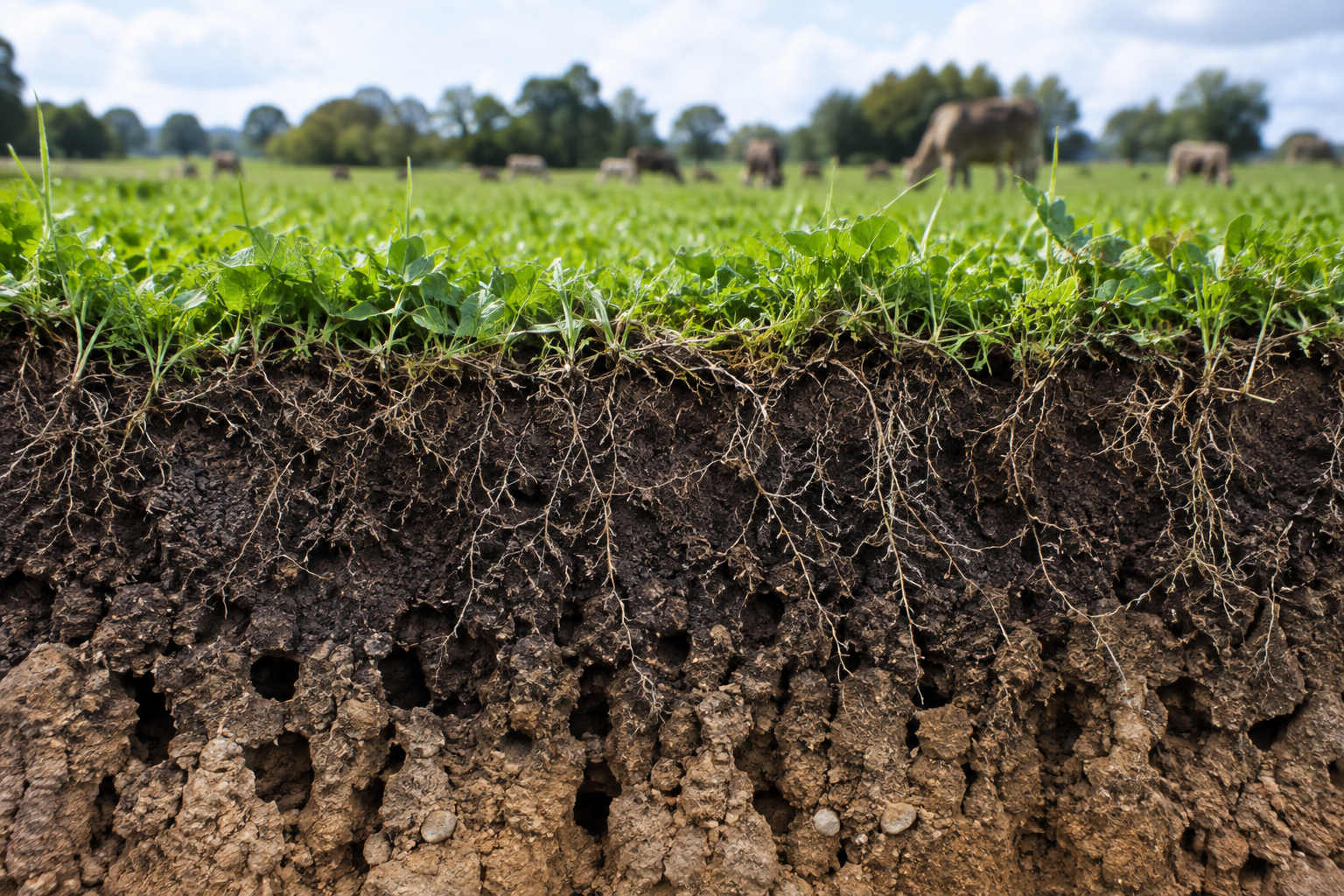
In this article I want to explore a little further the importance of maintaining soil structure.
I previously described how the ratio of Ca to Mg influences soil pore size which, in turn, determines how the air and water interact to deliver maximum dissolved oxygen (not O2) to the roots and their microbiome (the rhizosphere).
The Ca:Mg ratio also controls the behaviour of another key soil component in humus — the one per cent organic component that has a huge influence on the way soil water behaves.
Humus is a key part of the soil’s organic matter. It is a product of decomposition of plant residues, but specifically residues of fungal activity.
If you have cultivated a paddock in the recent past, or nuked it with glyphosate, the humus production brigade has been decimated and a vital part of your soil, and its functionality, has been lost.
Our hubris — thinking we know better than nature — harms the humus!
One of the key roles of humus is in soil water retention — frequently it is described as a sponge-like compound — actually a very good analogy. (Indeed, it does resemble that floppy kitchen thingy visually, structurally and functionally.)
The water holding capacity of humus is often misquoted as the organic matter’s holding capacity, which is 80 yo 90 per cent of its weight.
Humus itself can hold four to seven times its weight in water when provided the right conditions. That is, all of the soil water held by organic matter is held in the humus fraction, which is typically about 20 per cent of the organic matter.
To realise its full water holding potential, humus requires the space to expand, and as we have discussed, this space is controlled by the Ca:Mg ratio — precisely the same mechanism that controls soil pore size.
Now, the fact that the soil responds in an identical way to humus with every incremental change in the Ca:Mg ratio means that we have a double-whammy on both sides of optimum.
That is, relatively small changes in soil chemistry create big shifts in the water holding capacity of your soil.
To be clear, every time a tanker load of milk goes out the gate, the Ca:Mg ratio gets a little smaller. As a result, the soil gets a tiny bit tighter, and the space for humus to expand into is compromised, reducing its ability to hold water.
In effect, the humus-sponge is scrunched up a bit preventing it sucking up and retaining more water.
On the other hand, a high Ca:Mg, as it might be in sandy soil, or in limestone-rich soils, stretches the humic sponge such that some pores become too large and let their water go.
To maximise soil humus production, we need to find ways to get to five per cent soil organic matter, and have the fungal component of the soil’s microbiome thriving.
This is achieved by finding ways to avoid cultivation and chemicals, adding organic matter directly, managing soil chemistry and making sure your pasture mix contains species that promote mycorrhizal and other fungi.
If we work with nature rather than try to beat it, we can rapidly restore our soils.
Previous: Build it and they will come | Next: In a pickle over the peer review process
Part 8 of 9 — Dairy Sustainability, Soil Health & Farm Innovation Series
Originally published in Dairy News Australia, 22 January 2024, by Dr Les Sandles.
Have questions about this topic?
Our team is ready to help with expert advice tailored to your operation.
Contact UsRelated Articles
In a pickle over the peer review process
How should farmers balance peer-reviewed research with field experience and emerging innovation? This article considers the gap between statistical certainty, practical evidence and economically meaningful results on farm.
Soil & Pasture ScienceBuild it and they will come
Healthy soil biology depends on creating the right physical and chemical environment. This article explores soil structure, pore space and the relationship between calcium and magnesium in building functional dairy soils.
Soil & Pasture ScienceTaming the circular economy
Organic waste can be a valuable agricultural resource rather than simply a disposal problem. This article explores food and agricultural waste, nutrient recycling and the opportunities a circular economy can create for farming and soil health.